The importance of the meibomian glands in dry eye has only been recognized in the last few years. A group of worldwide dry eye experts spent over two years evaluating the meibomian glands (see the next blog posting for more information) and their role in the health and disease of the eye. The results of the International Workshop on Meibomian Gland Dysfunction were released earlier this year. They concluded that Meibomian Gland Disease (MGD) is an extremely important condition and very likely the most frequent cause of dry eye disease.
The workshop has helped to advance our understanding of the causes of dry eye and the best types of treatment. If you suffer from dry, irritated eyes it is critical to see a qualified eye doctor to determine if you have this condition. Artificial tears and other traditional dry eye treatment do not address the meibomian glands. If MGD is the cause of your dry eye, they will not provide the relief you seek and your condition will likely continue to worsen with time.

Dedicated to helping those with dry eye find the relief they seek
Friday, August 26, 2011

Wednesday, August 17, 2011
Meibomian Gland Dysfunction (MGD) and dry eye
The normal tear film has three layers made in several places on and around the eye. The top layer is an oily substance produced in the Meibomian glands that sit near the base of the eyelashes. There are approximately 15 glands on each upper and lower lid. This oily layer maintains a stable tear film and reduces evaporation of the tears. Research over the last couple of years has pointed to poor oily layer production as a leading cause or contributor to dry eye.
The normal secretion should be a clear free flowing substance that looks like oil (of course)! Meibomian Gland Dysfunction occurs when this oily secretion is in some way decreased. Some people have only slightly altered production which appears as small particles within the mostly clear fluid. Others have significantly decreased production which appear more like butter or Crisco than oil. The image below shows a thick white secretion from one of the lower meibomian glands.

The normal secretion should be a clear free flowing substance that looks like oil (of course)! Meibomian Gland Dysfunction occurs when this oily secretion is in some way decreased. Some people have only slightly altered production which appears as small particles within the mostly clear fluid. Others have significantly decreased production which appear more like butter or Crisco than oil. The image below shows a thick white secretion from one of the lower meibomian glands.
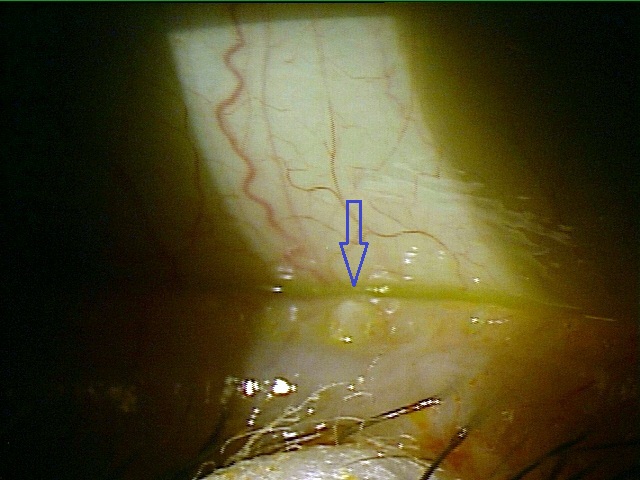
This gland is plugged and cannot secrete the normal oil. Treatment for this condition is targeted at improving the quality of gland production, ideally restoring it to the original oily state. Many treatments target this condition and are discussed in my book.
If you have dry eye it is important to see your eye care professional to determine if this condition exists.
Monday, June 27, 2011
Typical Dry Eye Patient
So what is a typical dry eye patient like? Most patients say their eyes feel tired, scratchy, irritated or tired. Most do not say they feel dry. The tear film serves as a protective layer for the cornea. An irregular tear film allows the cornea to be exposed causing these various symptoms.
Some say their vision is poor or fluctuates throughout the day. These fluctuations are directly related to dry eye. The tear layer on the eye is the front focusing (refracting) surface, if it is irregular or incomplete it will impact vision.
The following is a picture of an eye with a very irregular tear film:
![]()
Some say their vision is poor or fluctuates throughout the day. These fluctuations are directly related to dry eye. The tear layer on the eye is the front focusing (refracting) surface, if it is irregular or incomplete it will impact vision.
The following is a picture of an eye with a very irregular tear film:

This is a view from the microscope (called a slit lamp) of a patient with dry eye. The yellowish appearance comes from flourescein dye doctors put in the eye to visualize the tear film. Notice that the lower half is not a smooth color. It has dark spots and lines which are areas where the tears are breaking apart.
After blinking a normal eye should be smoothly and uniformly covered with tears for about ten seconds. With a dye in the eye it would appear as a smooth yellow tear layer. This is a dry eye patient about 2-3 seconds after they blink. Almost immediately the protective tear layer is breaking apart, exposing the corneal surface and degrading the quality of vision. This test performed by your eye doctor is called a Tear Break Up Time, or TBUT test. A normal score is 10 seconds or more. Less than 10 seconds and you could start having some dry eye problems.
Dry eye treatment is primarily focused on increasing the quality of tears and the amount of time they stay on the cornea. For information on dry eye treatment please visit dryeyeknowledge.com.
Wednesday, June 15, 2011
Dry Eye and Dr Millers mission statment
This is the first post of what will hopefully be many. I will be discussing all things related to dry eye. Here is my simple mission statement:

Provide clear and concise Knowledge, empowering patients to
find the correct Treatments they need to achieve the dry
eye Relief they seek.
I hope you visit often. A full list of dry eye treatment is available at dryeyeknowledge.com
Subscribe to:
Posts (Atom)